

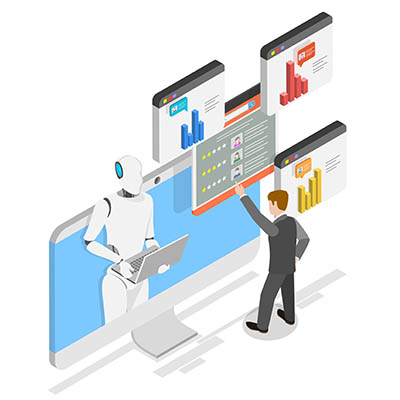
The emergence of Artificial Intelligence as a ubiquitous productivity tool marks a profound inflection point in the human story that parallels that of the printing press. For centuries, progress was measured by what could be created with hands and how they used the tools at their disposal. What’s changed is that we have now entered an era where the tool itself begins to think, synthesize, and create for itself. This shift represents more than just a technological upgrade; it is a fundamental reconfiguration of how we work. This month, we wanted to take a long look at the benefits AI is bringing humanity.
Unprecedented Productivity
In the 18th century, the steam engine replaced physical muscle, moving humanity from the field to the factory. AI represents a similar leap, but it targets knowledge work. By automating routine data processing, scheduling, and administration, AI allows the modern worker to bypass the grunt work that has defined office life for seventy years. Historically, when humans are able to pivot toward innovation and strategy, the quality of creative work is significantly enhanced.
This AI-fueled productivity isn’t just about doing things faster, it’s about doing things that were previously impossible. In the same way that the assembly line made automobiles accessible to the masses, AI-driven productivity is lowering the barrier to entry for complex tasks like coding, graphic design, and data analysis. This democratization of capability presents options to potential entrepreneurs that they would never have in previous times.
AI will likely come to change the way humans see value. If the output of a day’s work is no longer measured by the hours spent on a task but by the quality of the direction given to a machine, we are witnessing the final transition from a labor-based economy to a purely idea-based economy.
Scientific Acceleration
Historians often point to the “Scientific Revolution” as a period where new tools—the telescope, the microscope—unlocked worlds that had previously been hidden from view. AI is the microscope of the 21st century. It’s a technology capable of spotting patterns in billions of data points. In medicine, we are seeing the folding of proteins and the discovery of new antibiotics happen in weeks rather than decades. This is an exponential compression of the timeline of human progress.
This acceleration is particularly vital when viewed against the backdrop of our current global crises. Just as the development of nitrogen fixation to make fertilizers saved billions from famine in the early 20th century, AI-driven breakthroughs in fusion energy or carbon sequestration could be the technological pivot that preserves humanity. We are moving from a period of trial and error science to simulated science, where millions of experiments can be run digitally before a single test tube is touched in a lab.
Furthermore, this boom creates a compounding interest effect on knowledge. In the past, information was siloed by language and geography. Today, AI can translate, synthesize, and connect disparate research papers from across the globe instantly. By breaking down these silos, we are creating a collective global intelligence that ensures that the next great discovery isn’t lost in a dusty archive.
Preserving the Past
The tragedy of history is often the missing piece—the burned library, the eroded inscription, or the lost language. AI is currently performing digital archaeology that would have seemed like magic to historians fifty years ago. By using computer vision to read charred scrolls from Herculaneum or using neural networks to translate ancient cuneiform, we are effectively recovering lost centuries of human experience. This is our generation’s version of the Rosetta Stone.
Beyond mere translation, AI is helping us preserve the living history of our world. We can now create high-fidelity digital twins of historical sites threatened by war or climate change, ensuring that even if a physical monument is destroyed, its spatial and cultural data remains for future generations. This represents a shift from passive preservation—hoping things don’t break—to active preservation, where the essence of a culture is encoded into a permanent, digital record.
Finally, AI allows us to give voice to the voiceless of history. By analyzing vast troves of mundane records—shipping manifests, census data, and legal ledgers—AI can help historians reconstruct the lives of ordinary people who didn’t make it into the history books. This moves us away from “Great Man” theory and toward a more democratic understanding of our past.
Personalized Education
For most of human history, quality education was a luxury reserved for the aristocracy, often delivered through one-on-one tutelage. The 20th century brought the industrial model of schooling, which was standardized, rigid, and designed for the average person, which often meant it served no one perfectly. AI offers the first scalable opportunity to return to the Socratic Method, providing every student with a personalized tutor that adapts to their specific pace, interests, and cultural context.
This shift has the potential to break the historical cycle of poverty linked to educational access. In developing nations, where teachers may be scarce, an AI-driven interface can provide world-class instruction in literacy, mathematics, and vocational skills. This is the ultimate democratization of human capital, allowing a child in a remote village to access the same depth of information as a student at an elite university, effectively leveling the playing field for the first time in history.
Historically, every major expansion of literacy has led to a massive upheaval in social structures; think of how the printing press fueled the Reformation. As AI makes high-level education more accessible, we should expect a similar shift in global power dynamics. When billions of people are suddenly empowered with the tools of high-level reasoning and technical skill, the traditional hierarchies of expertise will be challenged, leading to a more meritocratic but also more turbulent social order.
Enhanced Decision Making
The Age of Reason was built on the idea that humans could use logic to solve the problems of the state. However, human leaders are often hampered by cognitive biases, short-term thinking, and the inability to process complex, interconnected systems. AI provides a strategic advisor that can model the long-term consequences of policy decisions, from urban planning to economic shifts, helping to avoid the catastrophic miscalculations that have plagued empires throughout history.
In the past, rulers relied on a small circle of advisors, often creating an echo chamber effect. AI, by contrast, can ingest data from millions of sources—environmental sensors, economic indicators, and public sentiment—to provide a more holistic view of reality. This could lead to a Precision Governance era, where resources are allocated more efficiently and crises are mitigated before they spiral out of control, much like an early warning system for the health of a civilization.
However, the historical precedent here is the double-edged sword. While better data can lead to better decisions, it also creates the temptation for technocratic overreach. The challenge for future historians will be to analyze whether we used these tools to enhance human freedom through better management, or if we allowed the algorithm of the state to replace the messy but necessary process of democratic debate. The goal is to use AI to inform the human will, not to replace it.
If you are trying to keep your people employed while gaining the benefits seen with this advanced technology, give the IT experts at Fusion IT a call today at (616) 828-5360.